




A QUEEN WHO TOOK A COUNTRY FROM THE EDGE OF THE ABYSS AND MADE IT LIVE ITS GOLDEN AGE: ELIZABETH I
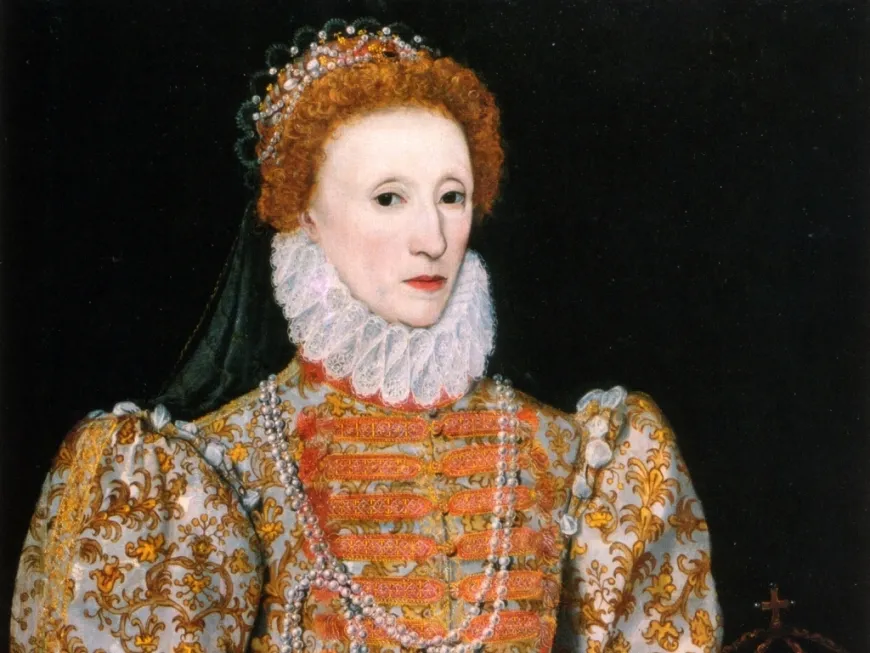
Considered as one of the most brilliant and stable periods in the history of England, the reign of Elizabeth I turned England into a world power with her political genius, cultural breakthroughs and religious reforms. Elizabeth I, who ascended the throne in 1558, was the last monarch of the Tudor Dynasty and was also known as ‘The Virgin Queen’. During her reign, England made great political, economic and cultural progress.
???? ACCESSION TO THE THRONE AND EARLY LIFE
Elizabeth I was born on September 7, 1533, in Greenwich, England. Her father was King Henry VIII and her mother was his second wife, Anne Boleyn. Her mother was executed by Henry’s orders in 1536, and Elizabeth was declared illegitimate.
She received an exceptional education from the best tutors of the time and spoke five languages fluently. She had deep knowledge in the Bible, history, classical literature, and politics. Before ascending the throne, she endured political intrigue and imprisonment during the reign of her Catholic half-sister Mary I.
In 1558, upon Mary I’s death, Elizabeth ascended the throne at the age of 25. Her coronation was celebrated with great public enthusiasm.
✝️ RELIGIOUS POLICY AND TOLERANCE
Protestantism in England had begun with her father, Henry VIII, but Catholicism was reinstated during Mary I’s reign. Elizabeth sought to end the religious turmoil:
-
In 1559, she officially restored Protestantism.
-
She assumed the title “Supreme Governor” of the Church.
-
Anglicanism was established as the official state religion.
-
In 1563, the 39 Articles defined Anglican doctrine.
Although criticized by both Catholics and extreme Protestants, Elizabeth pursued a pragmatic policy of religious tolerance. She avoided direct interference with personal beliefs while taking measures to prevent sectarian conflict from threatening national unity.
⚔️ INTERNAL AND EXTERNAL THREATS
Elizabeth's reign faced numerous threats both domestic and foreign:
-
In 1570, Pope Pius V excommunicated Elizabeth and encouraged her overthrow, legitimizing plots and rebellions.
-
One of the greatest threats was Mary, Queen of Scots, seen as a Catholic figurehead.
-
After the Babington Plot in 1586, Mary was executed in 1587.
???? THE SPANISH ARMADA AND VICTORY
King Philip II of Spain sought to depose Elizabeth and restore Catholicism in England. In 1588, he launched the “Great Armada.” However:
-
The Ottoman fleet's presence in the Mediterranean forced Spain to divide its navy, preventing full-scale deployment against England.
-
The English navy leveraged superior tactics.
-
Storms scattered the Spanish fleet.
England emerged victorious, marking its rise as a powerful naval force and strengthening Elizabeth’s position.

???? DIPLOMATIC RELATIONS WITH THE OTTOMAN EMPIRE
To counter the Catholic powers, Elizabeth turned to the Ottoman Empire:
-
In 1580, she secured trade capitulations from Sultan Murad III.
-
English merchants gained trading privileges in Ottoman lands.
-
This diplomatic success helped offset Spanish influence and bolster England economically and strategically.
Elizabeth corresponded in Ottoman Turkish with Sultan Murad, sent gifts, and thus initiated formal Anglo-Ottoman relations.
???? THE GOLDEN AGE OF CULTURE AND ARTS
Elizabeth's reign became one of England's most culturally vibrant periods:
-
Writers like William Shakespeare, Christopher Marlowe, and Ben Jonson reached new literary heights.
-
Her patronage of the arts led to the spread of public theatres.
-
Venues like the Globe Theatre were established.
This period saw strong Renaissance influences and a surge in cultural confidence across England.
???? EXPLORATION, COLONIZATION, AND ECONOMIC EXPANSION
-
Sir Francis Drake became the first Englishman to circumnavigate the globe.
-
Sir Walter Raleigh attempted to establish colonies in America (Virginia).
-
In 1599, the East India Company was founded, marking the start of England’s imperial expansion.
Trade, maritime power, and industry flourished, laying the groundwork for England’s emergence as a global power.
????️ GOVERNANCE AND STATE POLICIES
Elizabeth established a centralized monarchy with trusted advisors:
-
William Cecil (Lord Burghley) and Francis Walsingham were loyal and efficient statesmen.
-
She maintained a delicate balance with Parliament, convening it only 16 times in her 45-year reign.
-
Through local officials and courtiers, she ensured effective governance.
Elizabeth played a key role in shaping the English nation-state.
❤️ PERSONALITY, CELIBACY, AND FINAL YEARS
Elizabeth never married or had children, earning the title “The Virgin Queen.”
Her celibacy:
-
Kept her free from entanglement with domestic or foreign powers.
-
Helped preserve internal political balance.
-
Her famous statement, “I am married to England,” reflected her unique bond with the crown and her people.
In her later years, economic hardship, war debts, and court intrigue increased. However, in her 1601 “Golden Speech,” she expressed her love for her people and bid them a heartfelt farewell.
⚰️ DEATH AND LEGACY
Elizabeth died on March 24, 1603, at Richmond Palace. She was buried with great ceremony at Westminster Abbey.
With her death, the Tudor dynasty ended, and James I of the Stuart line ascended the throne.
???? HISTORICAL SIGNIFICANCE AND IMPACT
-
She resolved religious conflicts and established Anglican England.
-
She transformed England into a maritime empire.
-
She launched the English Renaissance through patronage of art, literature, and exploration.
-
She embodied powerful female leadership.
-
Elizabeth left behind a strong, united, and self-assured nation.
SUPPORT ME
You can support my work and discover more content about biology and evolution by following my academic Instagram account
What's Your Reaction?